

Seoulé Red Light Mask
A full-face LED mask in soft, foldable silicone. Red and near-infrared light, ten minutes a day, hands free — the light principle Korean skin clinics work with, built into something you wear on the sofa.
- 633 nm red and 850 nm near-infrared light in one mask — the two wavelengths most of the published research works with
- Soft medical-grade silicone that folds against the face, not a rigid plastic shell
- 10 minutes a session, hands free, nothing to wash off afterwards
- No UV, no abrasion, no downtime — light does not exfoliate skin
- 90-day money-back guarantee and a 12-month device warranty
Four reasons people put it on
Light is not a cream and not a procedure. It sits in its own category: nothing is applied, nothing is removed, and nothing about the skin surface is disturbed.
Firmness
Near-infrared light travels further than visible red and reaches the layer where the collagen scaffolding sits. That depth is the whole reason two wavelengths are used instead of one.
Tone
The most common thing customers report first is that skin looks less tired and more even in the mornings — before any change in lines is visible.
Calm
No acids, no retinoid, no abrasion, no peeling phase. There is nothing on the skin to react to, which is why light suits people whose skin has stopped tolerating actives.
A ritual you keep
10 minutes, hands free, while you sit. The routines people actually keep are the short ones — and with light, keeping it up is the entire mechanism.
What red light actually does
Everything you put on skin has to get past the surface. Light does not have that problem — which is why the mechanism is completely different from a cream's.

The light goes in
Red and near-infrared wavelengths pass through the surface instead of sitting on it. No pressure, no heat you would notice, nothing to absorb or wash off.

Cells take it up
Mitochondria — the part of a cell that makes its energy — absorb light in this range. Researchers call the effect photobiomodulation, and it is the reason red light is studied at all.

Your own structure
Whatever firmness appears is collagen your own skin built. That is why it takes weeks rather than minutes — and why it drifts back if you stop.

A schematic drawing of why the mask carries two wavelengths, not a measurement taken with this device. Penetration depth depends on wavelength, skin type and the area treated.
Where the light lands
A panel treats whatever happens to face it. A mask that folds against the skin holds every one of these areas at the same distance for the whole session — including the ones a handheld wand never reaches evenly.

The forehead
The widest flat area on the face and the first place horizontal lines settle in. The upper shell sits flush against it.
The outer eye
The thinnest skin on the face. The cutouts leave the eye itself clear while the shell covers the crow's-feet area on both sides.
The cheeks
The largest surface and the one people judge tone and texture by. This is usually where a change in how skin looks is noticed first.
Around the mouth
Nasolabial folds and the fine vertical lines above the lip — the area most home devices are shaped badly for.
The jawline
Definition along the lower face depends on the collagen underneath it, which is the layer the near-infrared wavelength is there for.
Under the chin
The skirt of the mask continues past the jaw, so the area under the chin is covered rather than left at the edge of the light.
The mask stops at the jaw — it is a face device. Neck, décolleté, hands and arms are what the K-Peptide Complex cream is sized for.
What you are actually buying
Specifications, not promises. Every figure below describes the device itself — none of them is a claim about what it will do for your skin.
Visible red. Works in the upper layers, where tone and surface texture sit.
Invisible to the eye and travels further — towards the layer where collagen is built.
Four to five times a week. Longer sessions are not the variable that matters.
Red and near-infrared sit at the opposite end of the spectrum from ultraviolet.
Soft and foldable, so the light source keeps its distance to the skin all over the face.
Charges from the supplied cable. No cartridges, no refills, nothing consumable.

It folds. That is the point.
A hard plastic shell touches a face at four or five points and leaves the rest at a different distance from the light. Soft silicone lies against the whole face, so the cheekbones and the hollow beside the nose get the same exposure.

Two straps, one button
Both straps adjust, so the mask sits without being held. The control pod on the strap starts and stops the session and shows the charge level — there is nothing else to operate and no app to install.
Device specifications are the manufacturer's. They describe the hardware, not an outcome — nothing on this page promises a result from any of these numbers.
What to expect, and when
Light works cumulatively. This is the sequence the research on red light is built around — not a promise of dates. Individual results vary and are not guaranteed.
Warmth and a red glow
You feel gentle warmth and see red through closed lids. That is the light working the way it should — not an effect on your skin yet.
Slight flush afterwards
Some people come out of the first sessions a little pink for a few minutes. It settles on its own. If it does not, stop and shorten the next session.
Nothing much to see
This is the honest part. In week one the only thing that has really changed is that you have started — and the mechanism needs repetition, not intensity.
The habit is the work
Four or five sessions a week beats seven for two weeks and none afterwards. Put it somewhere you sit rather than somewhere you tidy.
Tone before texture
What customers report first is how skin looks in the morning — less tired, more even. Appearance changes of that kind come well before anything structural.
Take a photo now
Same window, same time of day, no makeup. Skin changes too slowly for a mirror to be a fair judge of it.
The research window
Published studies on red and near-infrared light generally measure over eight to twelve weeks. That is the earliest point at which judging the device is fair.
Firmness, if it comes, comes last
Anything to do with the collagen layer is slow by nature. It is the last thing to change and the first to fade when you stop.
It holds while you keep going
Light signals, it does not permanently change skin. Most people drop to three or four sessions a week at this point and keep it there.
Nothing to replace
No cartridges, no gel, no refills. Beyond charging it, the running cost of the device is zero.
Send it back
Full refund of the purchase price within 90 days of delivery, used devices included. That is the whole point of a 90-day guarantee on something that needs weeks to judge.
How
Write to seouleskincare@proton.me and we send the return instructions. No phone call, no restocking fee.
Every window above describes what customers report and what the published research measures — not what this device is guaranteed to do for you.
10 minutes, and the order matters
Bare skin first, cream afterwards. Anything applied before a session sits between the light and the skin it is meant to reach.


Cleanse
Clean, dry, bare skin. No serum, no oil, no makeup — and no shimmer or SPF, which reflect light rather than let it through.
Put it on
Adjust both straps until the mask sits by itself against the face. Close your eyes and keep them closed for the session.
10 minutes
Sit or lie down. You can read, but not on a bright screen held close to your face. Four to five sessions a week is the rhythm to aim for.
Then the cream
Take the mask off, wipe the inside with a soft damp cloth, and do your evening skincare afterwards — this is the moment for it, not before.

The step after the light
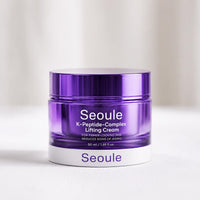
The mask covers the face and stops at the jaw. The K-Peptide Complex is the cream half of the same routine — seventeen peptides, sized for neck, décolleté, hands and arms too, and applied straight after a session on skin that has just been warmed.
Clinic equipment, shrunk to the face
Red light did not start as a home product. It started as a panel on an arm in a treatment room — big, expensive, and booked by the session. A mask is the same idea with the appointment removed.

What the published research covers
Red and near-infrared light has a body of peer-reviewed work behind it, including a controlled trial on skin appearance and collagen density and a widely cited review of low-level light therapy in skin. Those papers are listed at the foot of this page, and they are worth reading before you buy anything in this category.
They studied the wavelengths. They did not study this mask — which is exactly why no number from them appears anywhere on this page.
What we do not claim
- No clinical trial has been run on this device
- No percentage, timeframe or outcome is promised
- It is not a medical device and treats no condition
- It is not a substitute for a professional treatment or for sunscreen
- The before-and-after photographs are illustrative, not documentary

Built to the shape of a clinic device
Two wavelengths instead of one, an even distance from the skin across the whole face, and a fixed session length — the three things a clinic panel gets right and most handheld home gadgets do not.
What a clinic still has that this does not: supervision, higher output, and someone who looks at your skin first. If that is what you need, the mask is not a replacement for it.
What people report after a few months
1,900+ reviews, 4.8 average. Individual results vary and are not guaranteed.
 Before · After
Illustrative
BeforeAfter
Before · After
Illustrative
BeforeAfter
“I nearly sent it back in week three because I couldn't see anything. My husband was the one who said something at the end of month two — I look less tired in the mornings, and I hadn't noticed it happening.”*
 Before · After
Illustrative
BeforeAfter
Before · After
Illustrative
BeforeAfter
“I used to book a light session at a clinic in Seoul whenever I visited my mother. This is ten minutes on my own sofa instead, and I do it far more often than I ever managed to book anything.”*
 Before · After
Illustrative
BeforeAfter
Before · After
Illustrative
BeforeAfter
“What sold me was that there's nothing to put on. My skin stopped tolerating acids years ago, so most of the shelf is closed to me. This is the first thing I've been able to use without my face objecting.”*
 Before · After
Illustrative
BeforeAfter
Before · After
Illustrative
BeforeAfter
“The silicone is the difference. I had a hard plastic one that only really touched my nose and forehead. This one lies on my cheeks properly, and I can lie down in it without holding it on.”*
 Before · After
Illustrative
BeforeAfter
Before · After
Illustrative
BeforeAfter
“At my age I wasn't expecting a miracle and I didn't get one. What I got was ten quiet minutes a day and skin that looks better hydrated than it did in spring. At 71 I'll take that.”*
 Before · After
Illustrative
BeforeAfter
Before · After
Illustrative
BeforeAfter
“My face always looked flushed and blotchy by the end of a work day. It still does some days — but the evenings it doesn't are far more common than they were, and that's the thing I care about.”*
*Photos are illustrative representations, not documentary before-and-after photography. Individual results vary and are not guaranteed. Some reviewers received the product free or at a discount in exchange for their honest feedback. Reviews are shortened for length. Nothing in a customer review is a claim by Seoulé about what the device does.
Who should not use it
A light device is not a cream. These are the situations in which you should check with a doctor first, or leave it in the box.
Your eyes
The mask has open eye cutouts and the LEDs sit close to the face. Keep your eyes closed for the whole session. Do not look directly into the lights, and take the mask off if you get an afterimage or your eyes feel strained.
Medication that makes skin light-sensitive
Isotretinoin, tetracycline antibiotics, some diuretics and St John's wort can all make skin react to light. If you take anything in that group, ask the doctor who prescribed it before you start.
Light-sensitive conditions
Lupus, porphyria, solar urticaria and photosensitive epilepsy are reasons to speak to a doctor first. The same goes if you have a history of seizures triggered by flashing or bright light.
Skin that is not intact
Not on broken, burnt, sunburnt or freshly treated skin, and not over moles, pigmented lesions or anything a dermatologist is currently watching. If you have an active skin condition, ask them first.
Pregnancy and children
There is no meaningful safety data for use during pregnancy or on children, so the mask is for adults from 18, and pregnant customers should ask their doctor rather than assume it is fine.
Care and charging
Wipe the inside with a soft damp cloth after use — never submerge it and never run it under a tap. Charge only with the cable supplied, and stop using it if the silicone or the cable is damaged.
This device is a cosmetic light appliance for home use. It is not a medical device, it is not intended to diagnose, treat, cure or prevent any disease, and it is no substitute for advice from a doctor or dermatologist.
What people ask before they buy
What does the light actually do?⌄
Why two wavelengths?⌄
Is it safe for my eyes?⌄
Does it emit UV? Will it tan or burn me?⌄
What does it feel like?⌄
How often should I use it?⌄
When will I see something?⌄
Can I use it with the K-Peptide Complex cream?⌄
Does it work on darker skin?⌄
Is this a medical device or an FDA-cleared treatment?⌄
Who should not use it?⌄
Are the before-and-after photos real customers?⌄
What if it doesn't work for me?⌄
What if the mask itself develops a fault?⌄
How long does shipping take?⌄
Shipping
Free worldwide shipping on every order. Dispatch within one business day, delivery typically 2–5 business days with tracking.
Returns & warranty
90-day money-back guarantee from the date of delivery, used devices included. On top of that, a 12-month warranty on manufacturing faults. Refunds go back to the original payment method within 5–10 business days of us receiving the return.
Payment
Every order is a one-time purchase. There is no subscription, no recurring charge and nothing to cancel — a device is bought once and there is nothing to refill.
Photography. Photos are illustrative representations, not documentary before-and-after photography. Individual results vary and are not guaranteed.
What this page does and does not claim. Seoulé has not run a clinical trial on this mask. Where published research on red and near-infrared light is mentioned, it refers to studies on those wavelengths in general — not to this device — and no percentage, timeframe or outcome from those studies is claimed for it. Device specifications are the manufacturer's.
Further reading. Wunsch A, Matuschka K. A Controlled Trial to Determine the Efficacy of Red and Near-Infrared Light Treatment in Patient Satisfaction, Reduction of Fine Lines, Wrinkles, Skin Roughness, and Intradermal Collagen Density Increase. Photomed Laser Surg. 2014;32(2):93–100. doi:10.1089/pho.2013.3616 · Avci P, Gupta A, Sadasivam M, et al. Low-level laser (light) therapy (LLLT) in skin: stimulating, healing, restoring. Semin Cutan Med Surg. 2013;32(1):41–52. · Barolet D, Roberge CJ, Auger FA, et al. Regulation of skin collagen metabolism in vitro using a pulsed 660 nm LED light source. J Invest Dermatol. 2009;129(12):2751–9. doi:10.1038/jid.2009.186
This mask is a cosmetic light appliance for home use. It is not a medical device and is not intended to diagnose, treat, cure or prevent any disease. These statements have not been evaluated by the Food and Drug Administration. Individual results vary and are not guaranteed.
Questions? Write to seouleskincare@proton.me — we answer within one business day.